

You call support. Explain the issue. Then you get transferred to “the right person”, who asks you to explain everything again. Then you get transferred one more time. Maybe once more after that.
By the third explanation, you stop being a customer. You become a hostage.
But here’s what many contact center managers don’t see: it’s usually not the agent’s fault. They simply don’t have the right access, the right information, or the power to fix the issue right away. So they do the only thing they can do – send you to someone who might help.
Your customers go through this every day. According to SQM Group, аround 23% of consumers will stop buying from a brand entirely after one unresolved call. This isn’t just some abstract risk of losing customers. It’s a quarter of your regular customers who are leaving you.
There is a metric that shows this clearly: whether your team solved the problem during the first contact or delayed it for someone else to handle later. It’s called FCR or First Contact Resolution.
In this article, we’ll explain what FCR is, why it still matters more than many other contact center KPIs, and what five things you need to get right to make this number truly useful.
What’s First Contact Resolution (FCR) and why you need to track it
FCR is often confused with answering fast (fast response time). But answering quickly doesn’t mean solving the problem. A 30-second response time looks good on a dashboard. It doesn’t help much if the customer has to call three more times to actually fix the issue. FCR tracks one simple thing: was the customer’s problem solved during the first interaction?
In simple terms, FCR shows how often your team fixes the problem on the first try.
In more technical terms, FCR measures the percentage of customer requests that are fully resolved in the first channel and session, without the same customer contacting you again about the same issue within a set follow-up period.
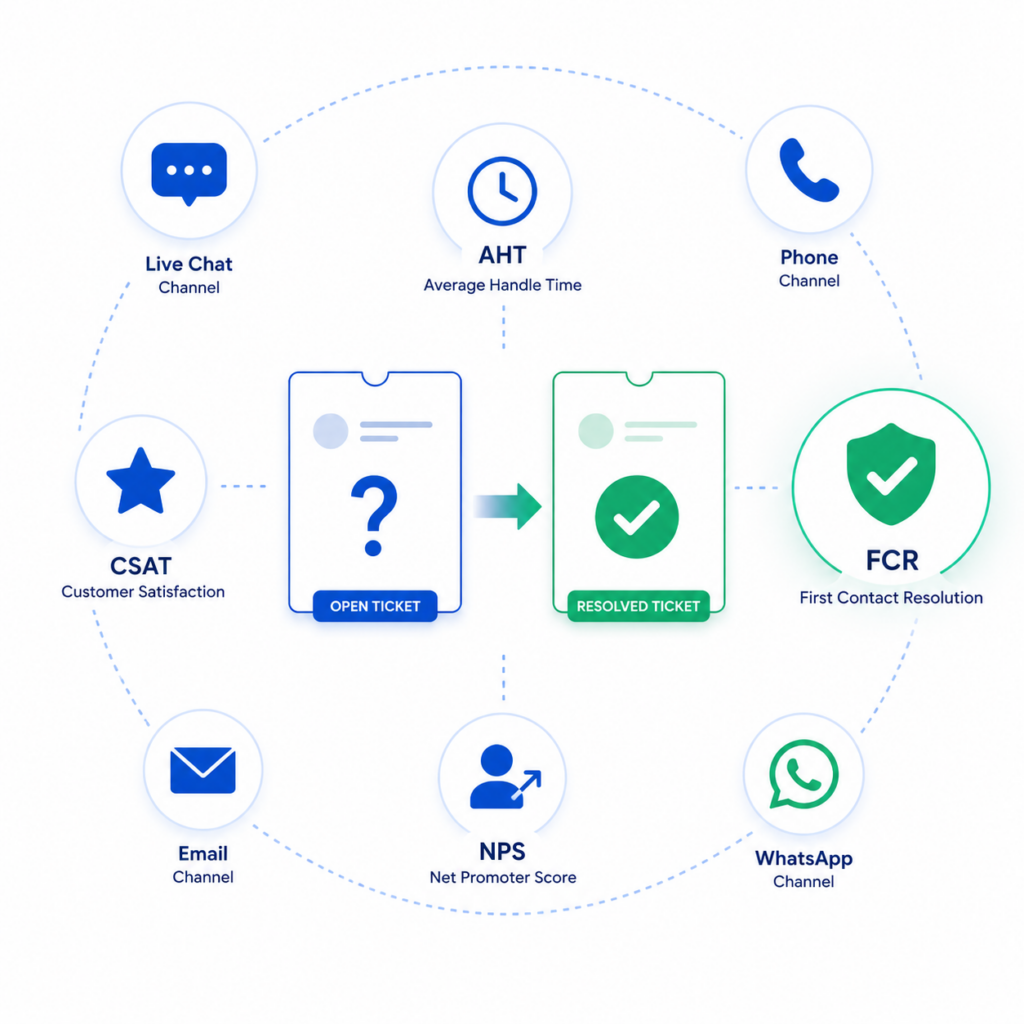
At first, the metric was called First Call Resolution. It was created for voice-only call centers in the early 1990s, when most customer support happened by phone. Back then, contact usually meant call. Now half of your customer interactions don’t start on a phone. They begin on chat, email, WhatsApp, sometimes inside the app. The newer term – First Contact Resolution – is more accurate. It covers every support channel, not just phone calls.
So why track FCR specifically? You probably already track AHT, CSAT, maybe NPS. Adding another KPI to the dashboard feels like more work, not less. Here’s the short answer: no other metric sits as close to the customer’s actual reason for contacting you.
AHT measures time. CSAT measures feeling. NPS measures loyalty. FCR measures the one thing the customer actually came for: did the problem get fixed?
SQM Group’s 25-year research found that no single KPI has a bigger impact on customer satisfaction than FCR. According to their data, every 1% improvement in FCR rate increases customer satisfaction by 1% and raises transactional NPS by 1.4 points. The same 1% gain saves a midsize contact center roughly $286,000 per year in operating costs.
Why First Contact Resolution Is an Important KPI
Most contact center managers nod when you mention FCR. Most don’t actually measure it across channels. Almost none can tell you what their cross-channel number is. Only the channel-by-channel split.
FCR affects three operational areas at once:
- the cost of repeat contacts;
- the customer’s patience;
- the workload your agents quietly carry.
Each one is enough on its own to justify tracking it. Together, they explain why First Contact Resolution has become the metric contact-center leaders care about most.
FCR reduces the cost of repeat contacts
Every repeat contact stacks: another agent’s time, another CRM update, another voucher offered to keep the customer from leaving. A cross-channel follow-up costs more than a single-channel one, because each channel switch resets the context.
Run the math on a 50-agent center. If each one handles 40 contacts a day, and 30% generate a callback, that’s 600 repeat contacts daily. At an average handle time of 6 minutes, that’s 60 hours per day burned on rework. Add the cross-channel multiplier, which is around 40% of customers switching channels while resolving a single issue, and the real waste gets closer to 80–90 hours per day.
FCR protects the customer experience
SQM’s research shows that CSAT drops by 15 percentage points for every callback on the same issue. When that callback lands on a different channel, the customer has to start over with someone who doesn’t see what they told the last person.
One Contact Resolution (OCR), which counts whether the issue got resolved across all channels combined, drops to about 59%.
FCR lowers pressure on your support team
Every cross-channel handoff that loses context puts the agent in this exact position. They look unprepared without doing anything wrong. And they absorb the customer’s frustration alone, because there’s no one else in the room.
This is the silent driver of contact-center burnout that no dashboard captures. McKinsey estimates agents spend 20–30% of their working time searching for information – often trying to rebuild context they never had.
How to measure First Contact Resolution
The FCR formula is the easy part. The methodology behind it is what separates an FCR number you can trust from one that just looks good in a slide.
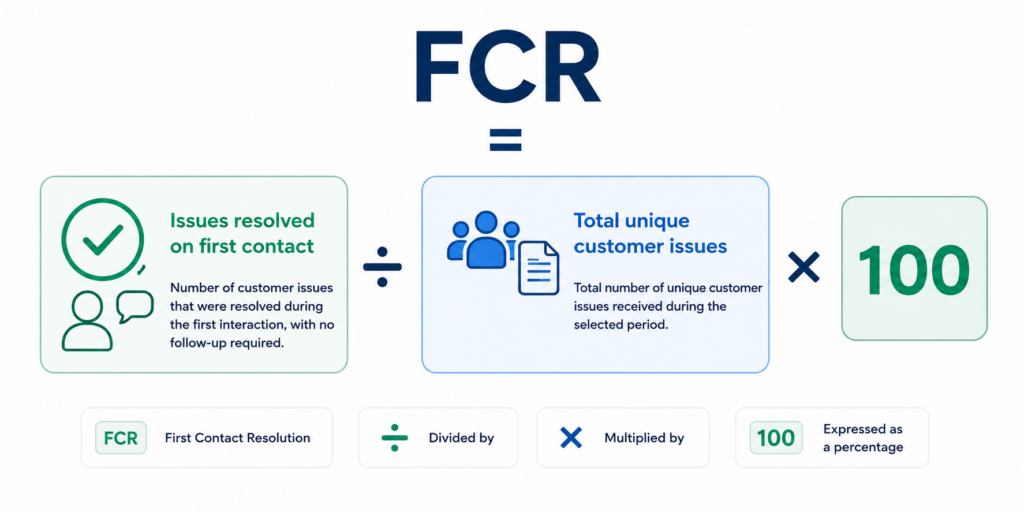
For example, let’s take one week. You received 1,200 unique customer issues. 720 of them were resolved without any follow-up across any channel. Then your FCR rate is 60%.
But this number does not show all the decisions behind the calculation. What counts as “first contact”? How do you identify the same customer across different channels? When does a channel switch mean the issue was not resolved on first contact?
These questions decide whether your FCR number is honest. If you answer them correctly, you get a metric you can actually use.
What counts as “first contact” across channels
The customer had one issue and one journey to solve it. The fact that they moved through several touchpoints is your problem, not theirs.
A useful definition of “first contact” should match the customer’s experience:
A first contact is the customer’s first attempt to solve the issue, no matter which channel they used and whether they spoke to a human.
That means failed chatbot conversations count. Self-service searches count if the customer later contacts support. Emails that never got a useful answer count as failed first contacts.
Stitching customer identity into one record
FCR across channels is impossible without one customer record across all channels.
If Anna chats on WhatsApp, calls from another phone number, emails from her work address, and writes on X from a personal account, your system needs to know this is the same customer. If it doesn’t, your CRM sees four different customers, four separate contacts, and four “resolved on first contact” tickets.
This is where many contact centers fail at FCR. They track the metric, but their data treats every channel as a fresh start. So the number looks good because the calculation is wrong. There are two types of customer identity data:
- Hard ID: email, phone number, account ID.
- Soft ID: cookies, device data, conversation patterns.
Hard ID is more reliable. Soft ID is faster, but it breaks when the customer changes device or channel. The practical fix: ask for a hard ID at the start of every interaction.
Internal vs external measurement
There are two ways to count a “resolved” case, and each one gives a different number.
Internal measurement uses your own systems. The agent marks the ticket as done, the CRM tracks repeat contacts, the dashboard reports the result. Fast, cheap, automated. And, according to SQM Group research, inflated by 10–20% compared to what the customer would actually say.
External measurement asks the customer directly. A one-question survey at the end of the journey: “Was your issue fully resolved this week?” Slower, more expensive, and the only number that reflects the customer’s real experience.
For FCR-contact, the gap between the two grows wider. Internal systems mark “resolved” channel by channel. Your dashboard adds up four wins where the customer felt one loss. Many contact center software platforms run post-contact surveys automatically, triggered when a case is marked closed across all channels.»
The honest setup is to run both. Internal numbers give you a daily operational signal. External numbers give you the monthly reality check. If the gap between them is more than 15 points, your agents are overestimating their wins, and that is what you need to fix first.
Time window for cross-channel cases
For single-channel FCR, the window closes when the agent marks the ticket. For FCR-contact, it closes when no new contact arrives across any channel within the defined period. The clock resets every time the customer touches any of them about the same issue.
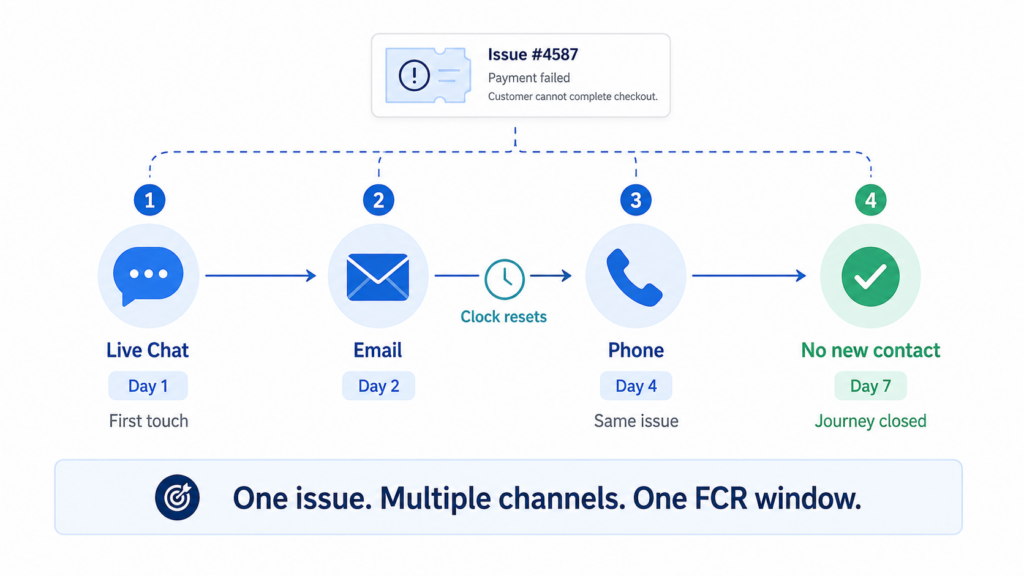
Three things follow:
- The journey starts at the customer’s first touch on any channel.
- The window length follows issue type: 7 days for billing, 30 days for technical cases.
- One channel resolving early doesn’t close the journey.
Your FCR levels will drop when you switch to journey-level windows. That is normal. The new number shows the customer’s real experience. The old one only showed how good each channel looked on its own.
Track FCR in a customer support software
Another way to track FCR is in customer support software. You can track FCR by AI chatbot or by human operators in such a software. For example, Intelswift collects all the important customer support metrics in one place so you can instantly view your team’s performance.
Final word
FCR has been used since the early 1990s, and unlike most contact-center metrics from that time, it is still relevant today. It asks the most direct question a customer service team can ask itself: did we actually fix the problem?
What’s changed is what surrounds it. The metric that used to live on a single phone call now lives across at least five channels: phone, chat, email, WhatsApp, in-app support, and more.
Before, agents could mark whether an issue was resolved. Today, companies also need customer surveys, because the customer’s answer can be very different from the agent’s answer. And before, FCR could stand alone. Today, it needs to be tracked together with CSAT and AHT to show the full picture.
What hasn’t changed: companies with world-class FCR rate win customers from everyone else. Not because their agents are smarter. But because their managers treat FCR as a system, not just a number.
They review definitions. They measure channels separately. They update knowledge bases monthly. They keep CSAT next to FCR on every dashboard. And when internal FCR and customer-reported FCR don’t match, they investigate the gap instead of ignoring it.
The other 95% are still arguing about whether 72% is a good number.